---
title: "From Google to HubSpot: Brilliant Employee Recognition Program Examples to Inspire Your Strategy"
description: Some businesses get recognition right and they enjoy better employee engagement and retention. This article give 7 examples any business can copy.
image: https://blog.accessperks.com/hubfs/big%20corporate%20party%20to%20celebrate%20employee%20awards%20recognition.jpeg
---
[](https://www.accessperks.com/)
[ ](https://www.accessperks.com/) [ How We're Different ](https://www.accessperks.com/#slideshow) [ Product Demo ](https://www.accessperks.com/#video) [ Blog ](https://blog.accessperks.com/)
REQUEST INFO
### DISCOVER THE DIFFERENCE
Learn how employers nationwide are saving employees thousands on their everyday purchases with **America's largest employee discount network**.
Request a tour of the discounts nearest your office, in the neighborhoods where your employees live, and in the places where they travel.
**
From Google to HubSpot: Brilliant Employee Recognition Program Examples to Inspire Your Strategy
15:53
# From Google to HubSpot: Brilliant Employee Recognition Program Examples to Inspire Your Strategy
Posted by [Ryan Marvel](https://blog.accessperks.com/author/ryan-marvel) on Apr. 8, 2026
- [Tweet](https://twitter.com/share)
Recognition isn't a perk. It's infrastructure. And most companies are underleveraging it.
For company executives and HR leaders, employee recognition functions as a retention mechanism, performance indicator, and culture-shaping system. Organizations with strong recognition programs create environments where employees feel valued, which directly impacts engagement, productivity, and long-term retention. In high-growth companies, this becomes even more critical. When recognition systems fail or remain informal, companies risk losing key contributors and disrupting operational momentum.
Looking at successful companies such as Google and HubSpot provides valuable insight. These organizations have embedded recognition into everyday operations rather than treating it as occasional appreciation. Across industries, successful programs share common patterns: structured frameworks, measurable outcomes, and alignment with company values.
This article explores real-world employee recognition program examples from major companies, showing how recognition works when it is designed as a strategic system.
### Key Takeaways
- Recognition programs are one of the highest-ROI retention investments available.
- Recognition only works when it's authentic, frequent, personalized, and tied to values. Hollow gestures can actually erode trust.
- The best employee recognition program examples succeed because they fit the culture they're building, not because they follow a universal template.
- Long-term employee retention improves when recognition is continuous and embedded in daily operations, not reserved for annual milestones.
- Making recognition visible signals organizational values as clearly as any mission statement.
- Staff appreciation examples that reinforce specific behaviors outperform generic praise because they tell employees exactly what to repeat.
- Growing companies can build effective recognition systems without large budgets by establishing clear criteria, distributing ownership, and committing to consistent rhythms.
- The companies with the best company culture examples of recognition share one trait: they treat appreciation not as a program to roll out, but as a practice to sustain.
[](https://hubspot-cta-redirect-na2-prod.s3.amazonaws.com/cta/redirect/263750/b3a53fd1-ac5c-494a-a965-d3cfea894727)
## Why Employee Recognition Matters for Long-Term Employee Retention
Employees who feel seen for their contributions are significantly more likely to remain with an organization. Recognition reinforces the message that individual efforts matter, not just financially, but in terms of broader organizational impact. When employees see how their work contributes to larger goals, engagement increases, collaboration improves, and productivity rises. Best yet, they stick around longer, improving a company's long-term employee retention. Employees who feel appreciated are also more likely to go beyond minimum expectations: they propose ideas, anticipate problems, and help colleagues.
A 2024 study from Gallup and Workhuman tracked nearly 3,500 employees over two years and found that those who received high-quality recognition were 45% less likely to leave their jobs.[1](https://blog.accessperks.com/employee-recognition-program-examples-google-hubspot#endnotes) Yet only 22% of employees say they receive the right amount of recognition. That gap is expensive: Gallup estimates a 10,000-person company can save up to $16.1 million annually by getting recognition right.[2](https://blog.accessperks.com/employee-recognition-program-examples-google-hubspot#endnotes)
The catch is that recognition has to meet a higher bar than most organizations are clearing. Gallup and Workhuman identify five pillars of strategic recognition: fulfilling, authentic, personalized, equitable, and embedded in culture. Meeting even one makes employees nearly three times as likely to be engaged.[1](https://blog.accessperks.com/employee-recognition-program-examples-google-hubspot#endnotes) Recognition that checks boxes without being genuine doesn't just fail; it can backfire, eroding trust in leadership itself. For leaders new to this concept, it often helps to revisit the fundamentals of [what employee recognition really means in modern organizations](https://blog.accessperks.com/what-is-employee-recognition).
The key lesson: recognition must support business strategy, not just sentiment.
## 7 Successful Recognition Program Case Studies from Leading Companies
The most effective recognition systems are not casual praise. They are structured programs with clear criteria, ownership, and measurable outcomes. The following companies represent some of the most deliberate approaches to employee recognition today. Each has made meaningfully different choices, which is part of the point. There is no single formula that works for every culture, but these successful recognition program case studies can give you a starting point in designing a program for your own unique workforce.
### Google Employee Recognition Strategy: Distributed Ownership at Scale
At tech giant Google, recognition is both top-down and peer-driven. Google uses manager-awarded Spot Bonuses for timely wins and No Name awards for team-level accomplishment. Notably, Google has shifted toward personalized, experiential rewards after research showed those had deeper emotional resonance than large cash bonuses. The Peer Bonus program allows any employee to nominate a colleague for a small monetary reward for going above and beyond. A companion tool called gThanks lets employees send non-monetary public recognition to one another.[3](https://blog.accessperks.com/employee-recognition-program-examples-google-hubspot#endnotes)
What makes the Google employee recognition strategy work is not any single program. It is the combination of real-time visibility, multiple channels for recognition, and a culture that treats appreciation as a shared responsibility. When any employee can recognize any colleague, recognition becomes a signal about organizational values, and that changes how people experience their contributions.
### HubSpot Culture and Rewards: Values as the Recognition Framework
At HubSpot, recognition focuses on impact rather than tenure. The company's recognition framework is tied to its HEART values (HEART stands for Humble, Empathetic, Adaptable, Remarkable, and Transparent) and employees can be publicly recognized for demonstrating these values, reinforcing the behaviors that shape the company's culture.[4](https://blog.accessperks.com/employee-recognition-program-examples-google-hubspot#endnotes)
Unlike traditional tenure-based awards, HubSpot culture and rewards emphasizes initiative and ownership, innovative problem solving, and measurable outcomes. This approach helped HubSpot earn recognition as one of the Best Company Cultures in 2024 according to Comparably, with an overall culture score of A+.[5](https://blog.accessperks.com/employee-recognition-program-examples-google-hubspot#endnotes) For fast-growing companies, this distinction is critical: rewarding tenure alone can dilute performance culture.
### Salesforce: Recognition Embedded in the Operating System
At Salesforce, recognition is integrated into the company's values-driven culture and into how the company is actually managed. The V2MOM framework requires every employee to document their goals publicly, and managers are held accountable for their team's engagement scores. Layered on top is the "Ohana" culture (ohana is Hawaiian for family), which extends belonging to employees, customers, partners, and community. Employees are recognized publicly for contributions aligned with Salesforce's core values of trust, innovation, and equality, with spot bonuses and nominations alongside a formal awards structure.[6](https://blog.accessperks.com/employee-recognition-program-examples-google-hubspot#endnotes)
What's distinctive here is accountability. Because recognition expectations are written into the V2MOM and tracked alongside business performance, appreciation doesn't depend on a manager having a good day. It becomes a structural output of how the company operates, which means it happens more consistently and equitably across the organization.
[](https://hubspot-cta-redirect-na2-prod.s3.amazonaws.com/cta/redirect/263750/e90de5ec-d3aa-4308-9b48-ba9d4a204fac)
### Adobe: Continuous Recognition and Feedback
At Adobe, recognition is closely tied to continuous performance conversations. In 2012, the company replaced annual performance reviews entirely with an ongoing feedback model called Check-in.[7](https://blog.accessperks.com/employee-recognition-program-examples-google-hubspot#endnotes) Under Check-in, managers and employees hold regular conversations about goals, progress, and career growth, decoupled from formal reviews. Feedback flows in any direction: manager to employee, employee to manager, or peer to peer. High performers receive spot bonuses, stock grants, and promotion opportunities at any point in the year.
This combination encourages ongoing improvement rather than once-a-year evaluations. A 2023 McKinsey study found that companies making this shift saw a 15% improvement in employee performance and a 20% increase in engagement.[8](https://blog.accessperks.com/employee-recognition-program-examples-google-hubspot#endnotes)
### Marriott: Recognition Rooted in Values and Ceremony
At Marriott, recognition flows from the top down and is taken seriously as a leadership responsibility. The flagship program is the J. Willard Marriott Awards of Excellence,[9](https://blog.accessperks.com/employee-recognition-program-examples-google-hubspot#endnotes) established in 1987 and named after the company's founder. Each year, managers and supervisors nominate associates for the company's highest honor, with winners recognized for achievement, character, dedication, effort, and perseverance. Ceremonies bring together honorees from around the world to share their stories in an Oscar-style event.
What makes Marriott's approach instructive is how seriously it treats recognition as a leadership act rather than an HR program. Managers are expected to know their people, nominate them deliberately, and present recognition in a way that feels personal and earned. Marriott has appeared on Fortune's 100 Best Companies to Work For.[10](https://blog.accessperks.com/employee-recognition-program-examples-google-hubspot#endnotes)
### Starbucks: Layered Recognition Tied to Craft and Values
At Starbucks, recognition operates across multiple levels and is explicitly positioned as a management tool. Store managers use Green Apron Cards to deliver on-the-spot recognition to partners (Starbucks' term for employees) when they go above and beyond, with Starbucks' own recognition guidelines instructing that cards be presented directly and in a way that feels personal, not perfunctory. The Partner of the Quarter program recognizes one partner per store each quarter, selected through a nomination process managed by store managers, and comes with a $75 bonus and a commemorative pin.[11](https://blog.accessperks.com/employee-recognition-program-examples-google-hubspot#endnotes)
The architecture is deliberate: Starbucks has built a recognition ladder where every level of the organization — barista, shift supervisor, store manager — has a formal pathway to be seen and celebrated. That structure keeps recognition from pooling only at the top, and ties it clearly to the craft and values the company cares most about.
### Access Development: Deliberate Recognition by Design
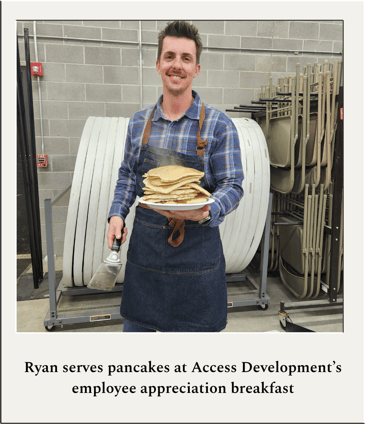Here at Access Development, we practice what we help our clients build. Every month at our company town halls, upper management reads aloud Making a Difference nominations. Anyone in the company can nominate any colleague, in their own words, describing how that person went above and beyond. The same meetings include service anniversary milestones, recognized publicly for the whole company to hear. Once a year, every team manager selects one member of their team for the Exemplary Service Award, a deliberate, manager-led act of recognition that puts the judgment and responsibility where it belongs: with the people who work alongside their teams every day.[12](https://blog.accessperks.com/employee-recognition-program-examples-google-hubspot#endnotes)
The results show up in the data. Access Development has earned several Best Workplace awards and Wellness awards year after year—all programs based primarily on anonymous employee surveys. We share these not to boast, but because they reflect the same principle this article is built on: when recognition is consistent, visible, and genuinely meant, employees notice. And they stay.
## Best Company Culture Examples and What They Share
Across these companies, several structural patterns appear consistently. Employee recognition program examples follow repeatable processes: manager and/or peer nominations, points systems, award categories. Recognition is tied to behaviors or outcomes that align with company values. Recognition is publicly shared across the company to reinforce desired behaviors.
None of these companies position any single recognition method as essential. Case studies across industries show that structured recognition programs improve engagement and reduce voluntary turnover while strengthening internal collaboration. The right mix depends entirely on your culture and the behaviors you're trying to reinforce.
## Staff Appreciation Examples That Scale with Your Organization
Smaller companies can implement structured recognition without complex systems. A simple three-layer model works well. Many of these approaches mirror [employee recognition programs that work especially well for small businesses](https://blog.accessperks.com/best-employee-recognition-programs-for-small-businesses), where simplicity and consistency matter most. Here are some staff appreciation examples and how often they should be used for maximum impact:
Everyday recognition: managers and/or colleagues nominate employees based on company values or KPIs, with results shared company-wide to keep appreciation timely and visible.
Quarterly impact awards: leadership recognizes individuals or teams whose work significantly improved performance, whether a product launch, a retention win, an operational improvement, or a cultural contribution.
Annual growth recognition: company-wide celebration of promotions, professional development achievements, and long-term contributions to company culture.
The [7 proven types of employee recognition](https://blog.accessperks.com/types-of-employee-recognition-programs) worth knowing about cover exactly how each of these dimensions translates into program design and day-to-day manager behavior. Even simple recognition systems can dramatically improve engagement if they are consistent and visible.
## How to Build Your Recognition Plan
Are you ready to build your recognition program? Companies in the design process can use the following employee recognition program examples for the first steps.
1. **Identify the behaviors that support business outcomes**: revenue growth, operational efficiency, customer retention, cultural strength.
2. **Tie recognition to measurable outcomes**: bonuses, points, rewards, growth opportunities.
3. **Clarify the specifics**: approval processes, budgets, frequency of awards, and documentation standards.
4. **Track the results**: employee turnover, engagement scores, internal promotions, participation rates. Review the program quarterly and refine it as the company grows.
Putting these principles into a repeatable, manager-ready process is where most organizations stall. A [step-by-step guide to building an employee recognition plan](https://blog.accessperks.com/how-to-build-employee-recognition-plan) that actually sticks walks through each of these stages in detail, including how to get leadership buy-in and roll out the program without disrupting existing workflows.
## Build Your Recognition Strategy with Access Perks
Recognition programs can protect top performers, clarify career pathways, reinforce desired behaviors, and align employee motivation with business results. For growing organizations, a well-designed recognition system can become a competitive advantage.
Access Perks gives organizations a private discount network — the nation's largest — covering restaurants, retail, entertainment, services, and travel, with pricing on hotels, flights, car rentals, and theme parks that outperforms public booking sites like Expedia. If you're building a recognition program and looking for a rewards component that employees will actually value and use, we'd love to show you what Access Perks can do. [Let's connect](https://www.accessdevelopment.com/).
### Endnotes / Resources
1. [Workhuman. Recognition and Retention: New Evidence of Recognition’s Long-Term Impact.](https://www.workhuman.com/resources/reports-guides/recognition-and-retention-new-evidence-of-recognitions-long-term-impact-gallup-report/)
2. [PR Newswire. Gallup-Workhuman Study Finds Organizations Can Save More Than $16M Annually by Having Culture of Recognition.](https://www.prnewswire.com/news-releases/gallup-workhuman-study-finds-organizations-can-save-more-than-16m-annually-by-having-culture-of-recognition-301550046.html)
3. [Google. Google Open Source Peer Bonus.](https://opensource.google/programs-and-services/peer-bonus/winner)
4. [HubSpot. Celebrate HEART with HubSpot.](https://community.hubspot.com/t5/Advocates-Blog/Celebrate-HEART-with-HubSpot/ba-p/1102635)
5. [Comparably. HubSpot Awards.](https://www.comparably.com/companies/hubspot/awards)
6. [Hays. How Salesforce build their award-winning workplace.](https://www.hays.co.uk/market-insights/article/how-salesforce-build-an-award-winning-workplace)
7. [Adobe. How Adobe continues to inspire great performance and support career growth.](https://www.adobe.com/check-in.html)
8. [Amazing Workplaces. Adobe’s Check-In: The Future of Performance Reviews.](https://amazingworkplaces.co/adobes-check-in-the-future-of-performance-reviews/)
9. [Marriot. J. Willard Marriott Awards of Excellence.](https://www.marriott.com/culture-and-values/awards-of-excellence.mi)
10. [Marriot. We Cracked the Top 10 in the Fortune® 100 List & More Workplace Awards.](https://life.marriott.com/blog/marriott-workplace-awards/)
11. [Starbucks. It starts with the green.](https://about.starbucks.com/stories/category/people-impact/partners/)
12. [Access Perks. Access Perks Honored with Workplace Awards: Lessons in Positive Workplace Culture.](https://blog.accessperks.com/access-perks-workplace-awards-lessons-in-positive-workplace-culture)
[](https://hubspot-cta-redirect-na2-prod.s3.amazonaws.com/cta/redirect/263750/5353aad5-c3c4-412b-a693-a6945d7bd816)
Topics: [employee engagement](https://blog.accessperks.com/topic/employee-engagement), [employee retention](https://blog.accessperks.com/topic/employee-retention), [employee recognition](https://blog.accessperks.com/topic/employee-recognition)

### Written by [Ryan Marvel](https://blog.accessperks.com/author/ryan-marvel)
[ ](https://www.linkedin.com/in/ryan-marvel-2aa2426)
Ryan Marvel is Vice President of New Product Development at Access. With nearly 20 years experience in business solutions, Ryan innovates new products that help businesses create meaningful connections with their audiences. His work is rooted in the belief that the right benefits and tools don't just solve problems—they build loyalty that lasts.
### Blog Sign Up
[](https://hubspot-cta-redirect-na2-prod.s3.amazonaws.com/cta/redirect/263750/9856683d-0c1d-437f-8476-dbb2a50fb252)
### Most Recent Posts
[](https://hubspot-cta-redirect-na2-prod.s3.amazonaws.com/cta/redirect/263750/c67363b0-84f7-4927-84d4-4701b4ff8c89)
### Trending Posts
[ ](https://blog.accessperks.com/employee-engagement-benefits-statistics-the-ultimate-collection)
[Employee Engagement & Benefits Statistics You Need to Know in 2025: The Ultimate Collection](https://blog.accessperks.com/employee-engagement-benefits-statistics-the-ultimate-collection)
[ ](https://blog.accessperks.com/access-perks-introduces-disneyland-resort-for-employees)
[My Oh My, What a Wonderful Deal from Disneyland Resort](https://blog.accessperks.com/access-perks-introduces-disneyland-resort-for-employees)
[ ](https://blog.accessperks.com/why-employee-discount-programs-work-an-hr-professional-speaks)
[Why Employee Discount Programs Work: From One HR Professional to Another](https://blog.accessperks.com/why-employee-discount-programs-work-an-hr-professional-speaks)
[
 ](https://www.linkedin.com/showcase/access-perks/)
© 2026 Access Development. Access is an Equal Opportunity Employer. All rights reserved.
[Privacy Policy](https://www.accessdevelopment.com/privacy-policy) [Trademark & Copyright](https://www.accessdevelopment.com/trademark-and-copyright) [Consent Preferences](https://www.accessdevelopment.com/#)
```json
{
"@context" : "https://schema.org",
"@type" : "BlogPosting",
"author" : {
"@type" : "Person",
"name" : "Ryan Marvel",
"url" : "https://blog.accessperks.com/author/ryan-marvel"
},
"dateModified" : "2026-04-23T19:59:30.716Z",
"datePublished" : "2026-04-08T13:00:00.000Z",
"headline" : "From Google to HubSpot: Brilliant Employee Recognition Program Examples to Inspire Your Strategy",
"image" : [ "https://blog.accessperks.com/hubfs/big%20corporate%20party%20to%20celebrate%20employee%20awards%20recognition.jpeg" ],
"mainEntityOfPage" : {
"@id" : "https://blog.accessperks.com/employee-recognition-program-examples-google-hubspot",
"@type" : "WebPage"
},
"publisher" : {
"@type" : "Organization",
"logo" : {
"@type" : "ImageObject",
"url" : "https://blog.accessperks.com/hubfs/accessPerks-1.png"
},
"name" : "Access Development"
}
}
```
```json
{
"@context" : "http://schema.org",
"@type" : "BlogPosting",
"author" : {
"@type" : "Person",
"name" : "Ryan Marvel"
},
"dateModified" : "April 23, 2026, 7:59:30 PM",
"datePublished" : "2026-04-08 13:00:00",
"description" : "Some businesses get recognition right and they enjoy better employee engagement and retention. This article give 7 examples any business can copy.",
"headline" : "From Google to HubSpot: Brilliant Employee Recognition Program Examples to Inspire Your Strategy",
"image" : {
"@type" : "ImageObject",
"url" : "https://263750.fs1.hubspotusercontent-na2.net/hubfs/263750/big%20corporate%20party%20to%20celebrate%20employee%20awards%20recognition.jpeg"
},
"publisher" : {
"@type" : "Organization",
"logo" : {
"@type" : "ImageObject",
"url" : "https://cdn2.hubspot.net/hubfs/263750/accessPerks-1.png"
},
"name" : "Access Perks"
}
}
```
```json
{
"@context" : "http://schema.org",
"@type" : "Organization",
"address" : {
"@type" : "PostalAddress",
"addressCountry" : "USA",
"addressLocality" : "Salt Lake City",
"addressRegion" : "Utah",
"postalCode" : "84119",
"streetAddress" : "1012 Beardsley Place "
},
"alternateName" : "Access Perks",
"areaServed" : {
"@type" : "GeoCircle",
"geoMidpoint" : {
"@type" : "GeoCoordinates",
"latitude" : "+40.718147",
"longitude" : "-111.9223077"
},
"geoRadius" : "150 km"
},
"description" : "Looking for employee discount programs? Learn why Access Perks -- America's largest employee discount network -- is rated #1 by employers nationwide.",
"email" : "info@accessdevelopment.com",
"image" : "https://cdn2.hubspot.net/hubfs/263750/accessPerks.svg",
"logo" : "https://cdn2.hubspot.net/hubfs/263750/accessPerks.svg",
"mainEntityOfPage" : {
"@id" : "https://blog.accessperks.com/employee-recognition-program-examples-google-hubspot",
"@type" : "WebPage",
"description" : "Some businesses get recognition right and they enjoy better employee engagement and retention. This article give 7 examples any business can copy."
},
"naics" : "518210",
"name" : "Access Perks",
"sameAs" : [ "https://www.facebook.com/AccessPerks/", "https://twitter.com/access_perks", "https://www.bbb.org/us/ut/salt-lake-city/profile/travel-club/access-development-corporation-1166-86010001", "https://www.linkedin.com/showcase/access-perks/" ],
"telephone" : "1-800-331-8867",
"url" : "https://www.accessperks.com"
}
```